



Mpox: Testing, diagnosis and clinical management
In July 2022, the World Health Organization (WHO) declared monkeypox (now called mpox) a public health emergency of international concern and called for a coordinated response to slow the spread of the disease. Since then, mpox has been raging in Africa but slowly simmering in the rest of the world. In mid-August 2024, the first case of clade Ib, a new clade of mpox, was reported in Sweden from a patient who had travelled to Africa. On August 14th, the WHO announced its second public health emergency of international concern relating to mpox.
Mpox is spreading in Australia; there have been 63 cases notified in NSW since mid-June, with transmission occurring in both regional NSW and Sydney. Victoria has reported 120 mpox cases since April 2024. The new clade 1b has not been reported in Australia yet.
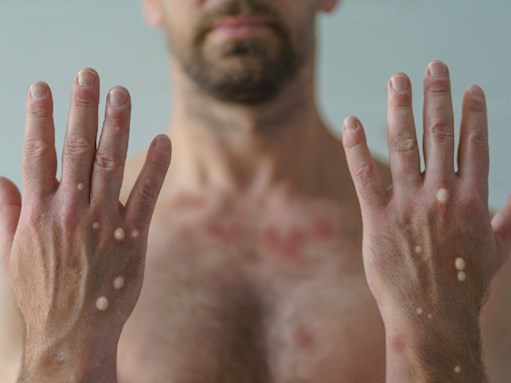
Figure 1. Raised vesicles on the hands of a male with mpox.
The mpox virus was first discovered in 1958, causing a pox-like disease in laboratory monkeys. The first case of human infection was reported in 1970 in a 9-month-old boy in the Congo. Mpox is an enveloped double-stranded DNA virus that belongs to the Orthopoxvirus genus of the Poxviridae family and is closely related to smallpox. The mpox virus has two distinct genetic clades: clade one (I), previously known as the Congo Basin clade, and clade two (II), previously the West African clade. The Congo Basin clade has historically caused more severe disease and was thought to be more transmissible.
-
How is mpox spread?
-
Clinical features
To date, most cases have occurred in MSM, but there have also been reports overseas of women and children acquiring the infection. The mean incubation period from the time of exposure to the first symptom appearing is 7 days, with 95% of individuals developing symptoms within 17 days.
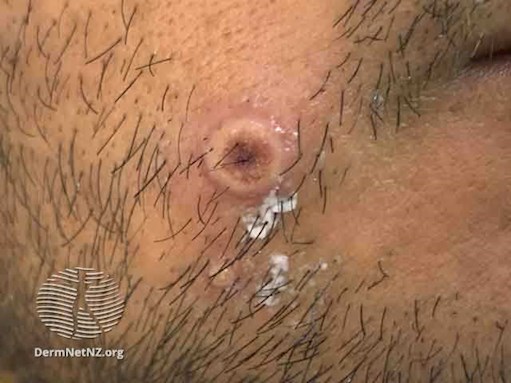
Figure 2. Umbilicated mpox vesicle on male’s cheek at day 4 of infection.
Initial symptoms include a flu-like illness with fever, malaise, headache and fatigue. This is often accompanied by lymphadenopathy. Shortly after the prodrome, a rash appears with lesions starting as macules and progressing to raised papules and vesicles (see Figures 1 & 2). The vesicles may fill with pus, ulcerate, then scab and fall off. The rash is typically distributed on the face, extremities and genitals. MSM may experience symptoms that include anorectal pain, proctitis with bleeding, penal oedema with balanitis and phimosis. Sore throat, odynophagia, epiglottitis and tonsillitis may also occur. The most common location of lesions reported in MSM were the anogenital area (73%), trunk and extremities (55%), face (25%) and palms and soles (10%). Most cases had fewer than 10 lesions, and some had only a single genital lesion.
Complications can occur in immunosuppressed individuals, pregnant women and young children. These include pneumonia, encephalitis and eye infections. Hospitalisation is uncommon and mortality rare, but at least four people in nonendemic countries have died. People should remain in isolation for the duration of the illness, which usually lasts 2 to 4 weeks. The disease is notifiable in Australia.
"If clinically indicated, testing for other likely pathogens should also be performed including herpes simplex, varicella zoster or bacterial infection."
Like many viruses, mpox cannot be diagnosed by symptoms alone. The symptoms closely resemble those of other rash-producing illnesses such as chickenpox, zoster, measles, syphilis, scabies, bacterial skin infections and allergic reactions. Laboratory testing is, therefore, essential for an accurate diagnosis.
-
Treatment
-
Vaccination
-
Prevention of Infection
About the Author

Dr Eric Chu
MBBS FRCPA FRACP- antimicrobial stewardship
- general infectious diseases
- infection prevention and management
- use of molecular methods in diagnostic microbiology
Dr Eric Chu graduated from The University of Western Australia with a Bachelor of Medicine/Bachelor of Surgery in 2007. He undertook his post-graduate training primarily at Sir Charles Gairdner Hospital, and completed his clinical microbiology and physicians training in infectious diseases. He obtained dual fellowship in 2020 after additional training at Fiona Stanley Hospital, PathWest and Princess Margaret Hospital.
Eric currently works as an Infectious Diseases Physician at Sir Charles Gairdner Hospital, and joined Australian Clinical Labs as a clinical microbiologist in 2020.
His interests include general infectious diseases, infection prevention and management, antimicrobial stewardship, as well as the use of molecular methods in diagnostic microbiology.