



Genetic Carrier Screening
in General Practice
By Associate Professor Mirette Saad
Published September 2023
Genetic Carrier Screening, available at Australian Clinical Labs, provides patients with information regarding their chances of having a child with a genetic condition such as cystic fibrosis (CF), spinal muscular atrophy (SMA), or fragile X syndrome (FXS). If the patient or the partner has a family history of any of these conditions, the chance of being a carrier may be higher.
Genetic Carrier Screening should be offered to every woman or couple
Australian clinical guidelines (RANZCOG & RACGP)1,2 recommend offering genetic carrier screening for common genetic conditions, such as cystic fibrosis, spinal muscular atrophy, and fragile X syndrome, to every woman or couple who are either planning or in the first stage of pregnancy, regardless of their probability of having these conditions.
Ideally, screening is performed prior to conception to offer greater reproductive choice. Early detection is paramount as it allows more time for counselling and provides greater reproductive options for those at risk. With carrier screening for CF, SMA, and FXS being Medicare-rebatable, testing can be offered earlier during routine appointments, alongside other prenatal screening tests.
Genetic Carrier Screening – Now Medicare-Rebatable
From 1st November 2023, carrier screening for cystic fibrosis (CF), spinal muscular atrophy (SMA), and fragile X syndrome (FXS) will be fully Medicare-rebatable. These Medicare items now make genetic carrier screening accessible to the wider Australian population; the test is covered once in an individual’s lifetime.
Extended Carrier Screening Options Available at Clinical Labs
Clinical Labs is pleased to offer patients two expanded carrier screening options at an additional out-of-pocket cost. For information about our Comprehensive and Ashkenazi Jewish Carrier Screening tests, including the conditions tested for, please click here.
A Cystic Fibrosis, Spinal Muscular Atrophy, and Fragile X Syndrome screening test
Genetic Carrier Screening gives patients information regarding the chances of their child having cystic fibrosis (CF), spinal muscular atrophy (SMA), or fragile X syndrome (FXS).
- One in 20 individuals are carriers of at least one of these conditions;
- 90% of carriers do not have a family history;
- One in 160 couples will be found to be at risk of having an affected child.
Cystic fibrosis (CF)
Approximately one in 25 individuals are carriers of CF, and CF genetic testing covers more than 75 common mutations in the CFTR gene. CF affects about 1 in 2,500 individuals and is a severe genetic condition that causes lung and gastrointestinal problems.
Spinal muscular atrophy (SMA)
SMA is an inherited neuromuscular disease historically associated with high morbidity and mortality. Approximately one in 35 individuals are carriers of SMA, and the SMA test identifies deletions of the SMN1 gene. SMA affects about 1 in 6,000 people.
Fragile X syndrome (FXS)
FXS is the most common cause of inherited mental retardation, affecting approximately 1 in 3,600 men and 1 in 6,000 women.
FXS carrier screening is recommended for females, as it is inherited in a different way to CF and SMA, and it only requires that the female has the gene change (number of repeats) in the FMR1 gene for there to be a risk of having a child affected by FXS.
Genetic Carrier Screening in General Practice
By Dr Caroline Rogers

Dr Caroline Rogers has been a GP on Sydney’s Northern Beaches for the last 20 years and has been working at South Steyne Medical Centre in Manly since 2021. Her practice focuses on women’s health and chronic disease, with a special interest in proactive, preventative care.
As GPs, we are ideally placed to discuss genetic carrier screening with patients. Over the last few
years, I have started offering this test as part of my routine preconceptual and pregnancy planning
consultations. When discussing carrier screening with patients, I often use the analogy of rhesus
status. Just like rhesus testing, the screening is done once and has implications for pregnancy
care. Knowing about it sooner rather than later allows us to put plans in place to manage and
prevent pregnancy complications. It is only necessary to test the partner if the patient tests
positive.
The advantage of obtaining the results of genetic carrier screening before a
pregnancy begins is that it reduces the stress and anxiety which can be associated with waiting for
results while pregnant. If the test is positive for one or more genetic mutations and the partner
also needs to be tested, the wait can be weeks. If this process is only initiated at the initial
antenatal visit, we are often well into the second trimester before the patient knows for certain
what the outcome is. This can significantly impact the joy and well-being many couples hope and
expect to experience during this time.
Pre-pregnancy testing allows this to happen in a
much less time-sensitive and emotionally charged environment. The patient and their partner can be
referred to a genetic counsellor to discuss the nature of the conditions being screened for, if
necessary, and their options in terms of pregnancy planning. This includes discussing
preimplantation testing if a positive result is found for both parties.
As this is a
once-in-a-lifetime test, and once cost is no longer a barrier, I anticipate it being raised more
often during pill checks and cervical screening appointments with younger women who are not actively
considering a pregnancy but would like to have this information to help them plan future fertility
choices.
Interpretation of results
CF and SMA
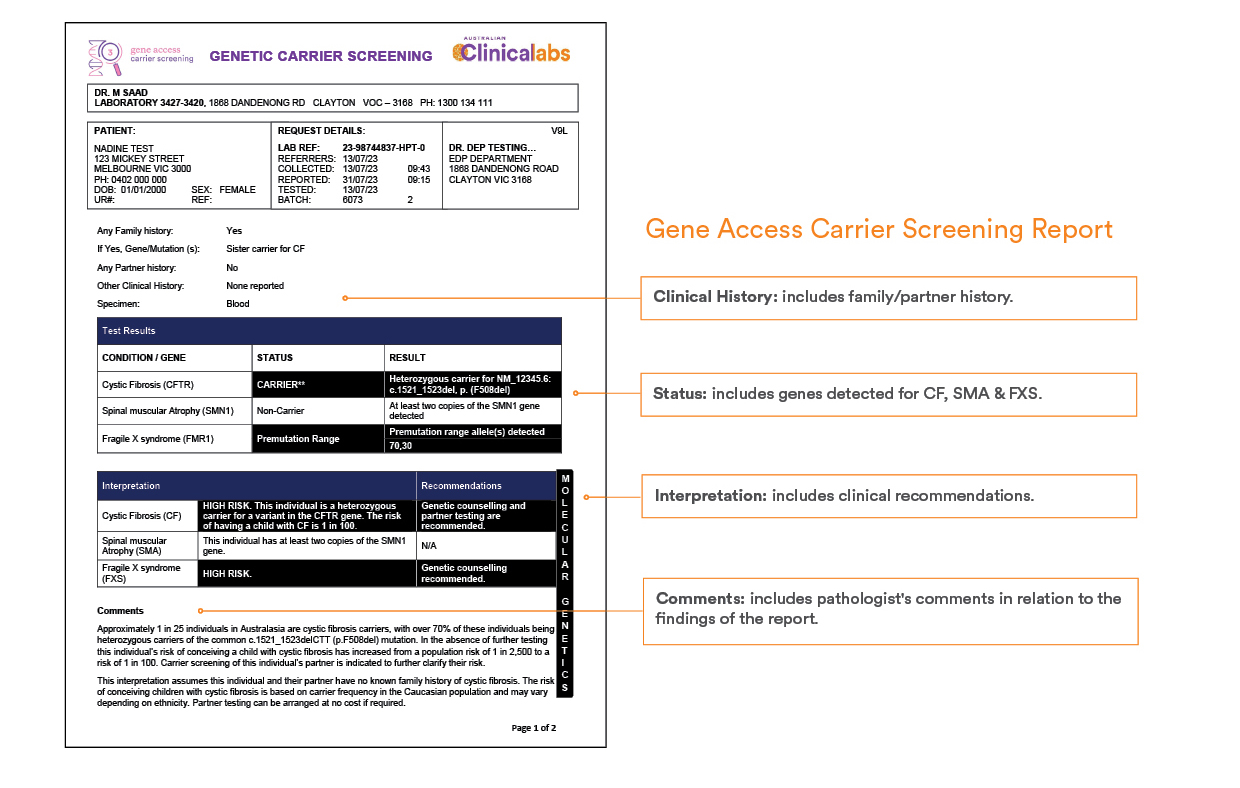
There are two possible outcomes when being tested for CF or SMA. Screening results may indicate your patient is either:
- A CARRIER: This means the test has identified that the patient carries a change in a copy of the CF or SMA gene. If this occurs, then testing of the patient’s partner for this condition(s) is recommended to further clarify the risk of having a child affected by that condition.
- A NON-CARRIER: This means that the patient was not found to carry any of the common gene changes tested for. Negative results can significantly reduce the risk of having an affected child with those conditions.
FXS
The table below shows the four different types of test results from FXS carrier screening based on the number of CGG repeats detected.

| Possible FXS test results | Number of CGG repeats identified |
|---|---|
| Normal Range | 5-44 repeats |
| Intermediate Range | 45-54 repeats |
| Premutation Range | 55-200 repeats |
| Full Mutation Range | >200 repeats |
Women with repeats within the normal range are not at increased risk of having a child affected with FXS. Women in the intermediate or premutation range are not affected by FXS (although they may present with clinical disorders), and they may pass on the risk to future generations or be at increased risk of having children affected by FXS. Women with repeats in the full mutation range are at increased risk of having children affected with FXS and should be offered a referral to a clinical geneticist or genetic counsellor for expert advice.
Genetic counselling
Positive cases are offered one genetic counselling session at no cost. Any follow-up consultations, if necessary, will incur an out-of-pocket fee.
- Clinical Labs will notify the referring clinician and provide contact details for the genetic counselling service.
- The referring doctor can either contact the genetic counsellor to schedule the appointment, or the consultation can be organised through the lab.
- Appointments are conducted over the phone and are generally available within 48 hours of referral. During the call, which lasts 15-20 minutes, the genetic counsellor will discuss the risk of having a child carrying this condition with the patient and their partner. It is also optional for the referring clinician to be on the call.
Please note: The genetic counselling request must be made within two weeks of receiving the partner’s CARRIER test results.
For information on how to order Genetic Carrier Screening with Clinical Labs, click here.
If you enjoyed this article, subscribe to our electronic Pathology Focus newsletter.

References
- The Royal Australian and New Zealand College of Obstetricians and Gynaecologists (RANZCOG) Guidelines.
- The Royal Australian College of General Practitioners (RACGP) Guidelines.
About the Author

Associate Professor Mirette Saad
MBBS(Hons) MD(Hons) MAACB FRCPA PhDAssociate Professor Mirette Saad
MBBS(Hons) MD(Hons) MAACB FRCPA PhD- antenatal screening
- cancer genetics
- clinical research and medical teaching
- endocrine
- fertility testing
- molecular genetics
- nipt
- precision medicine
Associate Professor Mirette Saad is a Consultant Chemical Pathologist and the National Director of Molecular Genetics at Australian Clinical Labs. She has a Fellowship with honours in Chemical and Molecular Pathology, with Microbiology sub-speciality, from overseas. A/P Saad received her NHMRC sponsored PhD degree in Cancer Genetics from Melbourne University and Peter MacCallum Cancer Institute. Along with her teaching and research roles, A/P Saad is a registered medical practitioner with AHPRA, a Chemical Pathology Fellow (FRCPA) at the Royal College of Pathologists of Australasia and a Member of the Australasian Association of Clinical Biochemists (MAACB). She is a Chair of the RCPA Chemical Pathology Advisory Committee, Member of the RCPA Genetic Advisory Committee, AACB and a Chair of the Precision Medicine Services at Australian Clinical Labs. At Clinical Labs, A/Prof Mirette Saad leads the Molecular Genetic testing for NIPT, antenatal screening, personalised drug therapy and cancer.
Related Pages

Targeted vs Genome-wide NIPT
Associate Professor Mirette Saad compares targeted and genome-wide NIPT approaches, outlining benefits, limitations and clinical considerations for prenatal screening.


Non-Invasive Prenatal Screening
Associate Professor Mirette Saad provides clinical insights on the importance of non-invasive prenatal screening for 22q11.2 deletion (DiGeorge syndrome), the second most common cause of developmental delay after Down syndrome.

Bulk-Billed Genetic Carrier Screening
Associate Professor Mirette Saad provides details on routine bulk-billed genetic carrier screening for CF, SMA, and FXS, including Medicare eligibility criteria and result interpretation.