



STI Case Studies
Recognising Systemic Manifestations in General Practice
By Dr Stella Pendle, Dr Linda Dreyer and Dr Sudha Pottumarthy-Boddu
Published
November 2024
Sexually transmitted infections (STIs) often present with classic symptoms localised to the genital area; however, they can also manifest in unexpected ways, affecting various non-genital sites. The following Clinical Labs case studies highlight the importance of clinicians remaining alert to the systemic (non-genital) manifestations of STIs, particularly in high-risk populations. As STIs continue to evolve and present atypically, healthcare providers must adapt their diagnostic approaches to ensure timely recognition and treatment.
CASE STUDY 1: An Unlikely Site for a Gonococcal Infection
By Dr Stella Pendle
Case Report
A sexually active homosexual man presented to his doctor complaining of discomfort in the right nipple. A purulent discharge was noted from a nipple piercing which had been in place for several months. Prior to this, the patient had not experienced any symptoms.
The patient was previously well and presented to his doctor for routine testing every 3 to 6 months. Nucleic acid testing (NAT) for gonorrhoea and chlamydia on urine and anal swabs were negative, as was a routine throat culture for gonorrhoea.
Laboratory Findings
A wound swab collected from the discharging skin site grew a scanty, pure growth of Neisseria gonorrhoeae (NG). A review of the Gram stain showed the presence of scanty Gram-negative intracellular diplococci resembling Neisseria gonorrhoeae.
The patient was recalled for further investigation and treatment. Additional NAT testing revealed the presence of NG in a throat swab, but urine and rectal swabs were negative. The patient denied any throat symptoms, and a throat examination was normal. He was treated with ceftriaxone and azithromycin.
Follow-Up
The patient returned for follow-up a few days later, reporting complete resolution of the nipple symptoms. He provided additional clinical history involving a casual male sex partner two weeks prior, with both oral-oral and oral-nipple contact, but denied contact with ejaculate.
In this case, transmission could have occurred through direct oral-to-nipple contact, or it could have been autoinoculation from the patient’s own saliva. Saliva has been shown to remain infectious in untreated patients for 2 weeks or longer.1 Transmission to other body sites via saliva should also be considered in high-risk patients.
Conclusion
The case illustrates two important points: wounds can harbour gonorrhoea and should not be overlooked during testing, and saliva can serve as a transmission source for gonorrhoea through autoinoculation or direct contact. NG is a fastidious organism requiring special culture conditions and may not be detected by routine laboratory culture methods. It may easily be missed if not specifically requested. Untreated gonorrhoea may spread via the bloodstream to distant sites, including joints, causing much more serious systemic infection.
Considering gonorrhoea transmission at extra-genital sites is important, particularly in high-risk patients. Increasing proportions of infections are extra-genital in men who have sex with men, and the number is also rising in other groups.2 In this instance, the low-grade asymptomatic infection in the throat might have gone undiagnosed. Gonorrhoea infection of the pharynx is often asymptomatic but remains infectious; the potential for transmission to others is high, especially when open wounds are present.
CASE STUDY 2: When a Rash Is More Than Just a Rash—Uncovering Secondary Syphilis
By Dr Linda Dreyer
Case Report
A 54-year-old female presented to her general practitioner (GP) with a rash localised to her legs, which was initially diagnosed and treated as eczema. However, she returned the following day, reporting worsening of the rash. During her second visit, she was seen by a different GP who noted changes on her palms, prompting further investigation. Syphilis serology was requested, revealing a positive result with an RPR titre of 1:256 and reactive specific Treponema pallidum serology (EIA and TPPA).
Clinical Presentation
Secondary syphilis typically occurs 4 to 10 weeks after the primary chancre resolves. It is characterised by systemic symptoms, including:
- Rash: The rash can be easily confused with guttate psoriasis, drug eruptions, or pityriasis rosea. It is often generalised, may present as copper-coloured spots, and can appear on the trunk and extremities, including palms and soles.
- Mucous membrane lesions: Painless mucous membrane lesions, known as mucous membrane pemphigoid, may occur.
- Lymphadenopathy: Swollen lymph nodes are commonly noted.
- Other systemic signs: Fever, malaise, and headache may also be present.
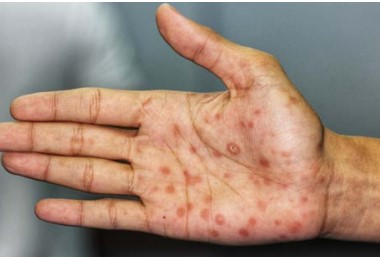
Image shows secondary stage syphilis rash spots on the palms of the hand.
Laboratory Findings
Diagnosis is established through serological testing. Initial testing typically involves treponemal-specific antibody assays, such as EIA or CMIA. If these results are reactive, supplemental treponemal tests (e.g., TPPA/TPHA, FTAABS) are performed. Non-treponemal tests (e.g., RPR, VDRL) are then used to monitor treatment response and confirm active disease. In this case, the elevated RPR titre of 1:256 indicates active syphilis.
Treatment
The recommended treatment for secondary syphilis is benzathine benzylpenicillin G, administered as two intramuscular injections of 1.2 million units (MU) each, totalling 2.4 MU. For patients with penicillin allergies, alternative regimens such as doxycycline may be used, although they are generally less effective.
Conclusion
This case emphasises the need for vigilance when assessing atypical rashes, as syphilis can mimic other dermatological conditions. Given that secondary syphilis is highly infectious to both sexual partners and the foetus, prompt identification and treatment are essential to prevent complications associated with untreated syphilis.
CASE STUDY 3: Gonococcal Ophthalmia Neonatorum—A Sight-Threatening Medical Emergency
By Dr Sudha Pottumarthy-Boddu
Case Report
A five-day-old ill neonate presented to general practice with redness, purulent discharge, chemosis of the conjunctiva, and significant oedema of the right eyelid. The general practitioner swabbed the discharge and prescribed eye drops.
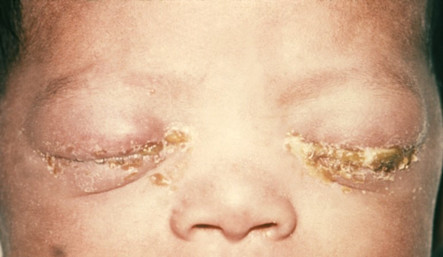
Image shows newborn with gonococcal ophthalmia neonatorum caused by a maternally transmitted gonococcal infection. Image credit: CDC/J. Pledger, Public Health Image Library (PHIL), #3766.
Laboratory Findings
- Gram stain: Numerous leucocytes and Gram-negative diplococci.
- Culture result: Growth of Neisseria gonorrhoeae.
- Susceptibility: Resistant to penicillin and sensitive to ceftriaxone.
The culture result was immediately notified to the general practitioner and public health authorities, and the neonate received appropriate parenteral therapy at the Children’s Hospital.
Understanding Ophthalmia Neonatorum
Ophthalmia neonatorum, a conjunctivitis in the neonatal period, occurs in 1% to 12% of neonates.3 However, the accurate incidence is unknown, as the notification of ophthalmia neonatorum as an entity is not universally mandated. Aseptic neonatal conjunctivitis (due to chemicals like silver nitrate) is unusual in present times. Septic neonatal conjunctivitis due to sexually transmitted bacteria, C. trachomatis and N. gonorrhoeae, is typically acquired during the birthing process, with C. trachomatis being the most common cause of neonatal conjunctivitis. The incidence of C. trachomatis neonatal conjunctivitis is markedly higher than that due to N. gonorrhoeae (US incidence: 8.2 versus 0.3 per 1,000 live births; over 20-fold higher).1 Other bacterial and viral aetiological agents of neonatal conjunctivitis include S. aureus, S. pneumoniae, H. influenzae, P. aeruginosa, adenovirus, and herpes simplex virus.3,4
N. gonorrhoeae can infect the eye either directly or indirectly:
- Vertical transmission occurs during the passage of the infant though the birth canal if the mother is infected with genital N. gonorrhoeae.
- While less likely, transmission is still possible if the infant is delivered by caesarean section.
- Auto-inoculation from genital gonorrhoea to the eyes via fingers or fomites (eg., clothes, towels) contaminated with their genital secretions.
- Contact with contaminated fingers or fomites of another person who has conjunctival or genital gonorrhoea.
While gonococcal ophthalmia neonatorum is a relatively rare entity, up to half of infants (48%) born to mothers infected with N. gonorrhoeae develop the disease. It presents as an acute illness that manifests 3-5 days after birth, characterised by hyperacute conjunctivitis, marked lid oedema, chemosis, and purulent discharge. If neglected, this can lead to corneal ulceration, globe perforation, and vision loss within 24 hours. Furthermore, it may result in disseminated disease with meningitis, arthritis, and septicaemia.5
Conclusion
Gonococcal ophthalmia neonatorum is becoming increasingly rare, thanks to the screening and treatment of gonococcal infection during pregnancy, along with the universal neonatal ocular prophylaxis. However, clinicians and microbiology laboratories must remain vigilant and employ methods to test, detect, and treat any outliers. Early detection and initiation of treatment are key to achieving a favourable outcome.
Further STI Testing Resources
To read the article, “The Changing Landscape of STIs” from the March 2024 edition of Pathology Focus, written by Dr Stella Pendle, Dr Linda Dreyer, and Dr Sudha Pottumarthy-Boddu, click here.
For detailed clinical information about chlamydia, gonorrhoea, and syphilis, including symptoms, testing recommendations, and treatment options, click here.
How to Order STI Testing for Asymptomatic Patients
Complete the Clinical Labs general pathology request form, listing the recommended STIs for asymptomatic screening: Gonorrhoea, chlamydia, syphilis, HIV, Hepatitis B and Hepatitis C.
In the Clinical Notes, add “STI Screen”.
Urethral swabs, first-pass urine (FPU) and vaginal/endocervical swabs. Note: Vaginal/endocervical swabs are more sensitive than FPU samples in female patients.
Serology for HIV, syphilis, Hepatitis B and Hepatitis C.
Bulk-billed, subject to Medicare eligibility criteria.
References
-
Chow, EP., et al., Detection of Neisseria gonorrhoeae in the pharynx and saliva: implications for gonorrhea transmission. Sex Transm Infect. 2016;92: 347–9. doi:10.1136/sextrans-2015-052399.
-
Dukers-Muijrers, N., et al., What is needed to guide testing for anorectal and pharyngeal Chlamydia trachomatis and Neisseria gonorrhoeae in women and men? Evidence and opinion. BMC Infect Dis. 2015; 15:533–45. doi:10.1186/s12879-015-1280-6.
-
Ochoa, K.J.C. and Mendez, M.D. (2023) Ophthalmia neonatorum, StatPearls [Internet]. Available at: https://www.ncbi.nlm.nih.gov/books/NBK551572/ (Accessed: 09 October 2024).
-
Eye care: Infections and conjunctivitis. Available at: https://www.cahs.health.wa.gov.au/~/media/HSPs/CAHS/Documents/Health-Professionals/Neonatology-guidelines/Eye-Care-Infections-and-Conjunctivitis.pdf?thn=0 (Accessed: 09 October 2024).
-
Gonococcal infections among neonates - STI treatment guidelines. (2022) Centers for Disease Control and Prevention. Available at: https://www.cdc.gov/std/treatment-guidelines/gonorrhea-neonates.htm (Accessed: 09 October 2024).
-
Centers for Disease Control and Prevention (CDC). (2021). Sexually Transmitted Infections Treatment Guidelines, 2021.
-
Workowski, K. A., & Bolan, G. A. (2015). Sexually Transmitted Diseases Treatment Guidelines, 2015. MMWR Recomm Rep, 64(RR-03), 1-137.
-
Young, H. H., & Peters, J. B. (2019). Clinical manifestations of syphilis. American Family Physician, 100(7), 426-433.
-
https://sti.guidelines.org.au/sexually-transmissible-infections/syphilis/
About the Authors

Dr Stella Pendle
MSc MBBCh DTM & H FRCPADr Stella Pendle
MSc MBBCh DTM & H FRCPA- general bacteriology
- sexually transmitted infections
- vre and hepatitis
Dr Stella Pendle completed a Master of Science degree in 1983 prior to graduating in Medicine from the University of the Witwatersrand, Johannesburg. She initially worked at the Hillbrow Hospital in Johannesburg and then at the Rietfontein Tropical Diseases Hospital. She obtained a Diploma in Tropical Medicine during this time. In 1999, Stella emigrated to Australia and worked as a resident at Gosford Hospital after completing the AMC exams. She proceeded to specialist training in Pathology (Microbiology) at Royal North Shore Hospital and ICPMR Westmead. On completion of her training, she moved to Symbion Laverty Pathology where she worked for four years as a Clinical Microbiologist. In 2009, she joined Pathology NSW as the supervising pathologist in charge of the microbiology, infectious serology and molecular diagnostics departments. She has continued in this role after the company merged with Australian Clinical Labs (formerly Healthscope Pathology). Dr Pendle has published several papers in her fields of interest, including VRE, chlamydial infections and HIV. She actively participates in Infection Control and promotes rational antibiotic prescribing at Healthscope Hospitals. She is a member of the Australian Society for Microbiology, the Australasian Society for Infectious Diseases and the Antimicrobial Society of Australia.

Dr Linda Dreyer
MBChB MMED(Path)(South Africa) FRCPADr Linda Dreyer
MBChB MMED(Path)(South Africa) FRCPA- antimicrobials
- infection control and molecular diagnostic assays…
Dr Linda Dreyer completed her undergraduate studies in 1996, receiving a Bachelor’s degree in Medicine and Surgery (MBChB) from the Faculty of Health Sciences, University of Pretoria, South Africa.
Following four years of clinical practice, as Medical Officer in the Department of Family Medicine she commenced specialisation in 2000. She was appointed as Registrar in Clinical Virology at the University of Pretoria/ Gauteng Province where she worked for two years and in 2003 she was appointed as Senior Registrar in Microbiology.
Dr Dreyer received her Master’s degree in Clinical Microbiology (MMed (Path)) from the University of Pretoria in 2006. She worked as a consultant for the National Health Laboratory Services (NHLS) in Pretoria until January 2008. During her time at NHLS she was involved in teaching medical students and microbiology registrars and gave lectures to nursing staff, medical students and specialists. She also sat on the Infection Control Committee and the Antimicrobial Stewardship Committee of the Pretoria Academic Hospital.
She came to Melbourne and joined Australian Clinical Labs (formerly Healthscope Pathology) in 2008 as a Senior Registrar and obtained Fellowship of The Royal College of Pathologists of Australasia (FRCPA) in 2010.
Dr Dreyer has special interests in the appropriate use of antimicrobials, infection control and molecular diagnostic assays in contemporary clinical microbiology.

Dr Sudha Pottumarthy-Boddu
MBBS FRCPA D(ABMM)Dr Sudha Pottumarthy-Boddu
MBBS FRCPA D(ABMM)- antimicrobial susceptibility trends and molecular…
Dr Sudha Pottumarthy-Boddu comes to us from Houston, Texas, where she was Assistant Professor in the Department of Pathology and Laboratory Medicine at the University of Texas, School of Medicine. She was also the Technical Director of the Clinical Laboratory Services at the Houston Department of Health and Human Services.
After graduating from medical school in India, Dr Pottumarthy-Boddu migrated to New Zealand and completed her Pathology/Microbiology Fellowship training with the Royal College of Pathologists of Australasia. She is a recipient of various awards and scholarships, including the Neil Prentice Memorial Prize of RCPA. She is also a Diplomate of the American Board of Medical Microbiology.
Over the last 10 years she gained experience in various hospital, research, and public health laboratories in the US, publishing over 30 articles in peer-reviewed journals and presenting at various national and international conferences. Detection of the first USA isolate of Enterobacter spp., with NmcA carbapenem hydrolyzing enzyme and establishing clinical significance of Nocardia verterana are noteworthy. Dr Pottumarthy-Boddu’s main research interests are antimicrobial susceptibility trends and molecular methods in the diagnosis of infectious diseases.
Related Pages

Rising STI Rates Post-COVID
Our expert pathologists discuss rising STI rates, emerging infections, and the critical need for testing, detection and treatment to control transmission.


Syphilis: An old enemy returns
Dr Linda Dreyer highlights the rising rates of syphilis and congenital infections and stresses the importance of routine antenatal screening and timely treatment to protect maternal and neonatal health.
STI Testing
Clinical guidelines for STI testing in asymptomatic patients, including opportunistic screening strategies and recommendations for managing co-infections.